
'As valuations of large-caps appeared to be out of whack, investors started lapping up quality mid-caps and small-caps, which were available at relatively comfortable valuations.'

The market breadth has turned sharply positive since May amid hopes that a decline in Covid-19 infections will lead to a revival in the economy. At 3.8, the advance-decline ratio (ADR) for May was the best since June 2020. So far this month, the ratio has remained above three - in simpler words, for every declining stock, there were nearly four advancing stocks in May and three this month. ADR is a popular market breadth indicator, with a ratio of more than two signalling an extremely bullish undercurrent.

'While the country has been hit hard from a strong second wave of Covid, we believe the markets are willing to look through that.'

Shyam Metalics and Energy (SMEL) will end the over two-month drought in the initial public offering (IPO) market. The steelmaker will launch its Rs 909-crore offering soon. SMEL has pruned its IPO size from Rs 1,107 crore, with the promoters deciding to offload shares worth Rs 252 crore as against Rs 452 crore planned earlier. The company has priced its IPO between Rs 303 to 306 per share.

Domestic equity markets are in elite company. In May, Indian markets joined select developed markets (DMs) such as the US, UK and Germany to record new all-time highs. Among emerging markets (EMs), Brazil is the other market to have logged new highs this month. Asian peers such as South Korea, Taiwan and New Zealand are currently between 2 per cent and 10 per cent below their previous highs made earlier this year. The domestic markets were among the worst-performing major global markets in April amid a lethal second-wave of covid-19 infections.

The Securities and Exchange Board of India (Sebi) has deferred the diktat requiring foreign investors to disclose their mobile number, email addresses and income details to depositories, a move believed to be aimed at curbing practices such as round tripping and money laundering. "Based on the representations received from MIIs (market infrastructure institutions), Sebi has decided to extend the deadline for making 6-KYC attributes mandatory for new accounts opened by 1 month to July 1, 2021. "Participants are accordingly requested to take note of the above and ensure compliance," NSDL said in a note on Tuesday. The regulator is also meeting custodians this week to thrash out a solution and address investors' concerns.

'It is critical that the Covid curve does not have a fat tail and the chain is broken quickly.'

While the recent volatility in the secondary markets is a concern, experts believe the sentiment towards IPOs is still buoyant.

The country's dash to a $3-trillion market cap is more a case of teamwork, than a few members doing most of the heavy lifting. Sample this: The share of top 100 companies to India's total market cap (BSE-listed companies' m-cap) is 67.3 per cent currently, less than what it has been when the nation hit previous milestones, such as $1 trillion, $1.5 trillion in 2007 or $2.5 trillion more recently in December 2020. In 2007, when India's m-cap topped the $1-trillion mark for the first time, the top 100 companies accounted for three-fourths of the total m-cap; at $1.5 trillion, the share was almost 80 per cent.

Companies in the small-cap universe are having a dream run - the Nifty Smallcap 100 index has shot up more than 25 per cent on a year-to-date basis, even as the benchmark Nifty is up 7 per cent. This is the best start for the index since 2017 when the Nifty Smallcap 100 index surged 32.3 per cent between January 1 and May 10. However, in terms of outperformance to the Nifty, this year's performance is the best in more than a decade. A combination of sectoral tailwinds and lack of institutional selling pressure has helped small companies escape from the correction triggered by the second wave of Covid-19.

Top officials said asking employees other than the fund management team to mandatorily invest a fifth of their salary goes against the principle of natural justice.

Industry players estimate the average payouts to be in the range of 50-75 per cent of the bankers' annual salaries. For the top performers, the bonuses could be 100-125 per cent.

Operational and compliance challenges foreseen for fund houses in deducting tax at source, resulting in possible TDS mismatches and disputes with investors.

The Nifty Bank index has come off 15 per cent from its peak in February, underperforming the benchmark Nifty which is down 6%.

Debt funds typically held 0-5 per cent of their portfolio in cash and cash equivalents before this Sebi diktat.

The SME segment has been grappling with lack of liquidity and lacklustre institutional participation.

'If Covid peaks at around 250,000 cases, I don't see the market fall much. If it becomes uncontrollable and goes up to 600,000 a day, then the market may fall.'

'Start-ups that generate a majority of their income in India are likely to opt for an Indian listing.'
The listing day gain-to-loss ratio for FY21 was 71 per cent, the highest since FY17, when it was 85 per cent.
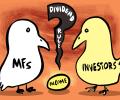
Experts believe the new norms may be an indirect way for Sebi to apply the brakes on dividend option plans in MFs.
